PLATYCERIUM FRONDS & GROWTH

Q&A

Q: How can you tell if a Platycerium is truly showing a mutation?

1. The trait remains stable
The same trait should appear consistently across multiple growth cycles
and on successive new fronds, rather than appearing as a one-time abnormality on a single frond.

2. Environmental factors have been ruled out
The trait should remain present under normal, non-extreme growing conditions,
including light, temperature, watering, and fertilization.
Heat stress, chemical damage, nutrient imbalance, pests, diseases, and other
environmental factors that may cause abnormal growth should first be ruled out.

3. The trait remains stable through vegetative propagation
Offsets or stolon-derived pups should continue to display the same trait,
even when grown under different conditions.

Make bold hypotheses. Verify them carefully.
Q: Should old Platycerium fronds be removed?

Aging fertile fronds can be removed, but they don't necessarily need to be.
During natural senescence, the plant can still reabsorb nutrients from aging fronds,
so you can simply allow them to dry out and fall naturally.
However, if a frond shows signs of disease or an active lesion, removing the affected tissue
may help prevent the problem from spreading.
For basal fronds, it depends on whether they interfere with routine care.
If too many layers have accumulated and make it difficult for the sphagnum moss to absorb
water properly, selective trimming can make watering and maintenance easier.
Q: If there are no new fronds but nothing is dying either,
how can I tell if my Platycerium can still recover?

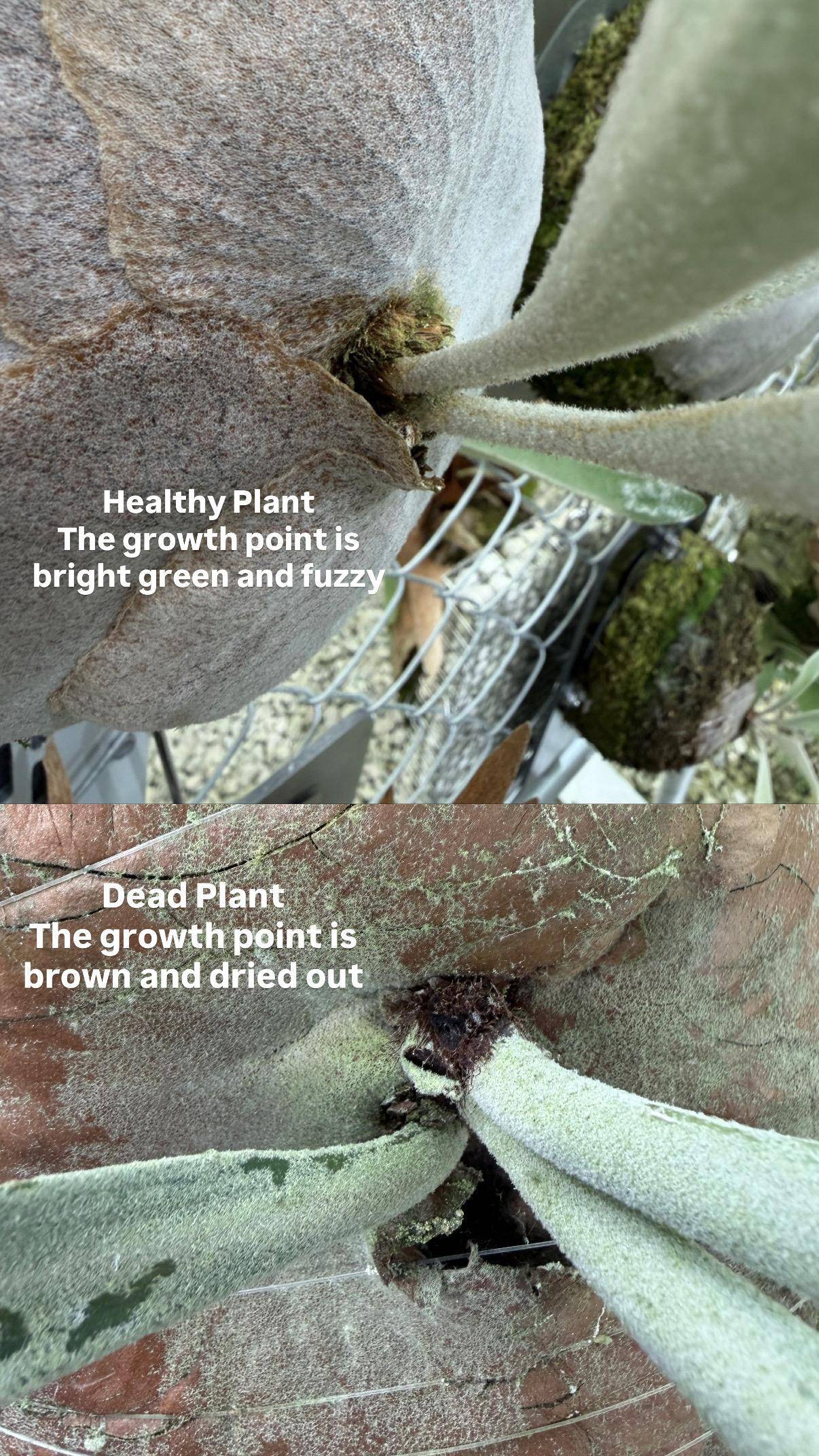
Check the growth point first.
If the growth point is still green and fuzzy, the plant is still alive.
You can adjust its growing conditions, such as ventilation and watering,
and continue observing for new growth.
However, if the growth point has turned completely brown and dried out,
the chances of recovery are extremely low.
Q: My Platycerium fronds are turning yellow.
Is it underwatering or overwatering?

First, look at which stage of growth the affected frond is in.
If the newest growth begins to yellow and dry out, check whether something
in the growing environment is causing stress.
Common causes may include theplant becoming too dry or conditions being excessively hot and dry.
If the plant continues to produce healthy new growth while only the older fronds
gradually turn yellow, this is usually part of the plant's natural aging and senescence process
and is generally nothing to worry about.
Q: What is the white fuzz on Platycerium fronds? Should I wipe it off?

The white fuzz on Platycerium fronds consists of tiny structures called trichomes.
These fine hair-like structures can help reflect intense light,
reduce heat and light stress on the leaf surface, and limit water loss.
They act as a natural protective layer for the plant.
So, when the plant is healthy and growing under suitable conditions,
a white or silvery appearance does not necessarily mean mold or disease, and there is no need to wipe it off.
The density and appearance of trichomes can also vary between species, cultivars, and growing conditions.
Q: Why does my Platycerium keep growing “hands” but no “face”?

Here, “hands” refer to fertile fronds,
while “face” refers to basal fronds.

If your Platycerium keeps producing fertile fronds without developing basal ronds,
there are two main factors to consider:

1. Environmental humidity
Basal fronds help protect the rhizome and collect water and organic matter.
Under consistently high-humidity conditions, the timing and development of basal fronds may vary.

2. The plant's growth stage
This is especially common in young plants. During the juvenile stage,
the growth pattern between basal and fertile fronds may not yet be fully established.

A young plant may produce several fertile fronds in succession
before eventually developing new basal fronds.

As long as the growth point remains healthy and the plant continues to grow,
give it some time and observe before making major changes to its environment.
Stay cool & keep growing

By Olivia

THE TRIBUS STUDIO ®


